Showing posts with label Healthcare. Show all posts

Tuesday, May 27, 2014

Hospitals Extend RFID and RTLS to New Applications

As service organizations driven by process efficiency and patient safety, hospitals have been an "early adopter" of RTLS and RFID asset tracking.   Early applications included monitoring the location of medical equipment in patient rooms, as well as monitoring patients and medical staff. 


Now primary care providers are deploying RFID asset tracking in more diversified settings and applications, from inventory management of consumables and supplies to process compliance in central sterile and in-house testing labs. 

Common RFID-enabled processes in Hospitals include:


  • Specimen Tracking
  • Managing Medication Across Multiple Supply Locations
  • Surgical Instrument Processing
Surgical instrument processing is well suited to RFID automation, which enables error proofing the intake, inspection, sterilization and kitting of surgical instruments and scopes, as illustrated below:
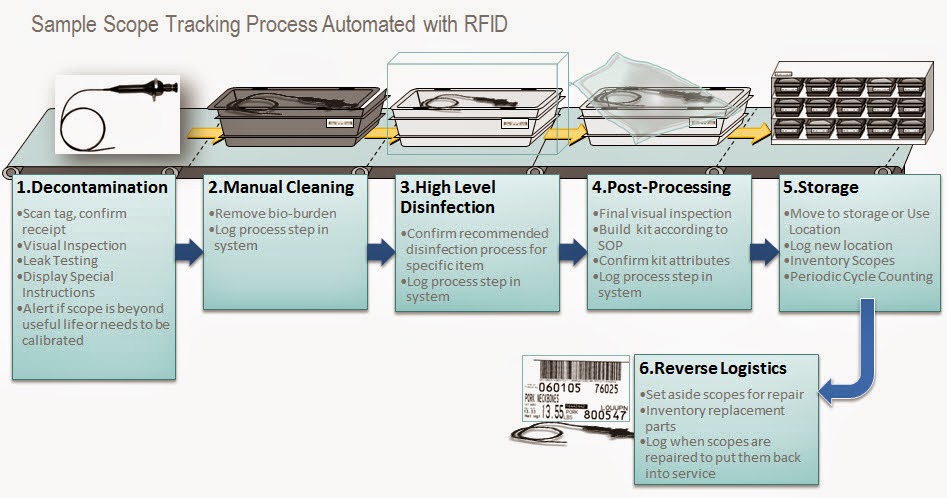
Automating a Medical Scope Tracking Process with RFID


Friday, February 28, 2014

RFID's Role in Healthcare Process Automation

RTLS and RFID have played an important role in improving Healthcare process efficiency, tracking medical equipment, staff and patients in busy hospital facilities.

RFID is now being used as an automation tool, much as it has been in industrial manufacturing, to monitor and manage critical process flows in hospitals and laboratories.  Central sterile and laboratory processes require the same checks and balances as complex assembly processes, after all.  Building a surgical kit, and managing the disinfection cycle of surgical instruments is not much different than kitting shipments in a manufacturing facility or managing materials in a clean room environment.

At the HIMSS show this month, we demonstrated a surgical instrument tracking application with RFID using a Motorola handheld reader and ruggedized tags from Xerafy.  It resulted in many interesting discussions on how process automation may be one of the hidden benefits of an Intelligent Hospital.


Thursday, January 2, 2014

RFID and RTLS in Healthcare and Life Sciences [Infographic]

It's a common misconception that there's only one use case for RTLS and RFID in Healthcare: tracking hospital equipment across patient rooms.   We're seeing primary care providers, testing labs and pharmaceutical manufacturers implementing the technology for dozens of other use cases, within core operations and across the value chain.  The infographic below illustrates some of these applications.

Tuesday, November 19, 2013

Harsh Reality for RFID & RTLS -- It's About the ROI

Just presented at RFID Journal's RFID in Harsh Environments event on the evolving business case and ROI metrics for RFID.   The definition of "Harsh Environments" is quite broad, but it generally applies to extreme temperatures/operating conditions, remote worksites and hazardous or highly-regulated materials.   Harsh Environments span multiple industries including Oil & Gas, ChemicalsAerospace & Defense, Healthcare and Industrial Equipment -- as shown below:
RFID Application Areas in Harsh Environments


Once we get past the definition of a harsh environment, it's important to look at the value drivers for RFID and RTLS (we support all Auto-ID modalities, so we use the terms interchangeably).   The industries listed above, by nature, have complex asset management challenges that are well suited to RFID automation.   We see three primary drivers for RFID adoption in harsh environments:
  1. Cost Pressure -- where 100s of millions of dollars/euros/pounds of capital equipment impacts working capital allocation -- a reduction in redundant equipment or write-off/repair of non-working assets can have an impact on operating profit.
  2. New Programs -- with new exploration projects, aircraft programs, infrastructure projects comes revenue opportunity -- and customer scrutiny.  Customers are increasingly demanding transparency for programs in progress - not just at critical milestones.  RFID visibility can help provide this transparency, leading to stronger partnerships and minimizing the risk of contract breach.
  3. Operational Risk -- the only way to address compliance, audit and safety issues is to build error proofing into the process automation. 


Wednesday, September 18, 2013

RFID & RTLS in Healthcare - Part 2 - What Assets to Track?

A common myth in healthcare is that RTLS and RFID are only used to track the location and movement of medical equipment.  


But that neglects the fact that healthcare and life science firms have infrastructure to maintain like every other business. Hospitals, pharmaceutical firms and research labs have capital equipment that needs to be tracked and traced; IT assets; consumables and supplies; tissue samples; tools; vehicles and transportation devices.

And location is not the only thing that needs to be tracked. Since consumables and tissue samples are perishable and specialized equipment needs to be regularly calibrated, maintained and/or sterilized, updating an asset's location along with its current status helps ensure patient safety. 

The following table lists examples of assets tracked with RFID in Healthcare:


Thursday, September 5, 2013

Getting Started with RFID Tool Tracking

Managing Manufacturing Equipment with RFID
Managing Tools & Equipment Across a Manufacturing Facility

There's been quite a bit of confusion in the the market on what RFID tool tracking really does, what sorts of tools can be tracked, and how automating tool tracking processes with RFID really works (especially when it involves ERP, MMS or Service & Maintenance systems).
Tracking Indirect Materials with RFID
Tracking Indirect Materials in the Field

Last month, we ran two instructional sessions on how to get started with RFID Tool Tracking.  Topics covered included:
  • Planning tips (based on tool/equipment type, operating environment, maintenance schedule, contractual requirements and usable life)
  • Best practices (based on customer deployments in Industrial Manufacturing, Aerospace & Defense, Oil & Gas and Life Sciences) 
  • Process automation examples and scenarios with adjacent processes, incl. Work-in-Process Tracking


We covered a lot of ground in 30 minutes!  Online registration for the video recording is at: 

Monday, July 8, 2013

RFID & RTLS in Healthcare: Part 1 - Who Uses RFID in Healthcare?

A common myth is that large hospitals are the only adopters of RFID and RTLS technology in healthcare.  

The reality?  RFID Asset Tracking is being widely used in a number of different healthcare segments other than hospitals. 


These include medical labs, emergency medical services, doctor’s offices and clinics, and even manufacturers of healthcare products, supplies and medications. Even relatively small doctors’ practices are using asset tracking to track equipment for service and maintenance schedules, as well as keep track of incoming medication and consumables. And, hospitals are deploying asset tracking in highly diversified settings and applications, from inventory management of equipment and supplies to compliance and real-time asset location.  

The following table lists some of the most common business processes for RFID  and RTLS Asset Tracking:

Common RFID-RTLS ApplicaTIONS – HEALTHCARE


Wednesday, May 29, 2013

5 Myths About Asset Tracking in Healthcare

In any new application area, it’s easy to run into misconceptions or just flat-out errors about the applicability or challenges associated with a technology such as asset tracking. Asset tracking has a long, impressive track record in a wide variety of industries with similar supply chains and workflows as healthcare – such as industrial manufacturing and even retailing. Here are a few common myths and the real-worth truths about the utility of asset tracking in healthcare, from an article in Healthcare Technology Online:


Monday, May 6, 2013

Redefining Tool Tracking for Equipment and Indirect Materials

Tools = Tooling = Indirect Materials = Conveyances = Equipment

Every industry and every business function needs to track capital equipment, whether it's used for service, manufacturing or  distribution operations.

For service providers in Healthcare, Aviation, Utilities and Transportation, the cost of tracking equipment is not just related to the value of the asset, but how often it is needed. A missing wheelchair or infusion pump can compromise patient care. A missing towbar or test kit can result in flight delays. 
For manufacturers - particularly for those with complex processes , production equipment and tooling is highly-specialized, single-sourced and difficult to replace. Misplaced or out-of-spec equipment can derail a production schedule.
For logistics providers - conveyances and reusable transport items (RTIs) must be carefully managed - missing conveyances make for missed shipments.


On the OATSystems website we have separate sections for equipment tracking and tool tracking based on how indirect materials are defined in different industries.  

When building our "asset wall"  and asset tracking for RFID Journal Live this year, we used sample assets from healthcare, manufacturing, aviation and transportation.   In this case, we didn't need to define "tool tracking" in a thousand words - we had the pictures, (of surgical trays, medical supplies, infusion pumps, autoclaves, ventilators, conveyances, bearing pullers, digital calipers, roll cages, composite tooling...) instead.

Tuesday, March 5, 2013

How RFID and RTLS Can Save Lives

HIMSS '13 showcased RFID and RTLS technologies in multiple ways:  the Intelligent Hospital Pavillion and speaker sessions from primary care providers, including the US Veterans Health Administration.

The key message?  By automating administrative and operational tasks, RFID and RTLS technology enable healthcare professionals to focus on patient care.  In short, these "invisible" technologies can save lives.  The following article in Healthcare IT News sums it up.